A trade show lead capture app visitors choose to use
A trade show lead capture app usually means a badge scanner or a tablet form that your own staff have to operate. QDevine turns the capture into a 90-second quiz on the visitor's own phone, with a consent line on every lead and a CSV, Google Sheet or CRM webhook at the other end.
Why a quiz beats a badge scanner
A badge scanner records whoever walked within reach of your staff. It gives you the badge record and nothing else: no reason for the visit, no sign the person wanted to hear from you, and a rental bill per show that only applies where the organiser offers scanners at all. A tablet form is cheaper but somebody has to hold it, and a visitor who is asked to type their email into a stranger's iPad will usually decline.
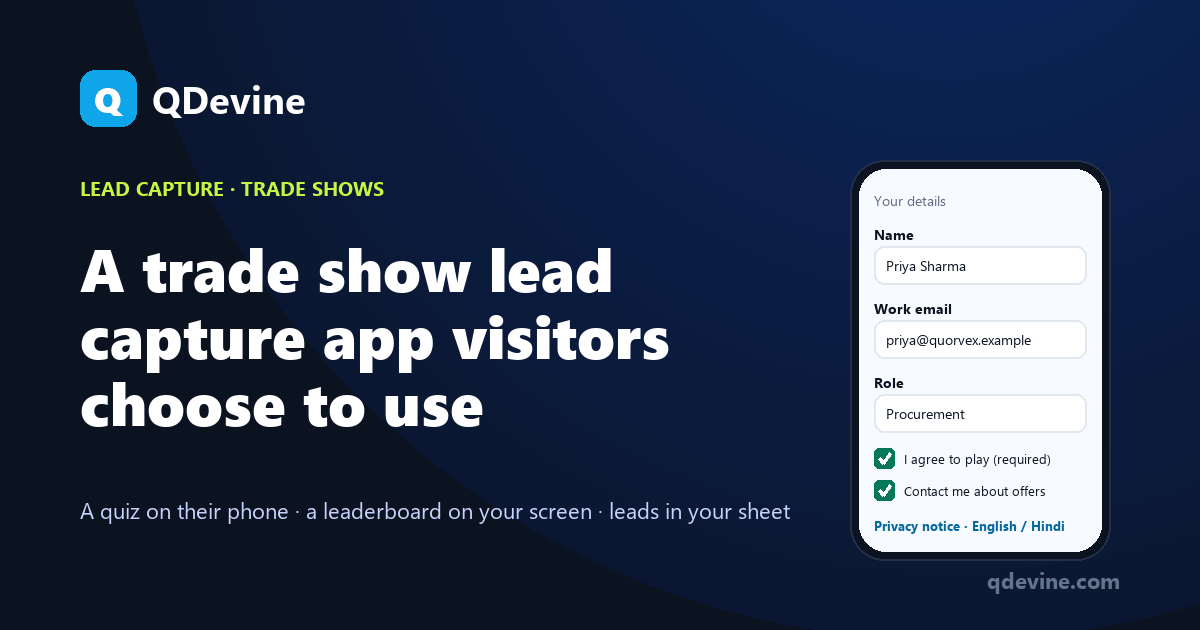
A quiz changes the order of events. The visitor scans a QR because there is a leaderboard on the TV and a prize at the end of the day. The registration screen is the price of entry, and it takes fifteen seconds. Then the game starts. Exhibitors who run a stall game commonly report that people volunteer their details more readily when they get something back for them, and a live rank is something back.
You also learn more. Add a registration field for role, city or product of interest, and an optional survey question after the last answer. The answer lands in the same row as the score, so the person following up knows what the visitor cares about.
A trade show lead capture app with consent built in
India's Digital Personal Data Protection Act expects a notice and a clear consent before you use a person's details for marketing. Most badge-scan exports cannot show either. In QDevine the form carries two separate lines: one to take part in the quiz, one to be contacted afterwards. A privacy notice is generated from your event settings and opens from the consent line, in English or Hindi.
Every tick is written to a consent ledger you can download: the exact wording the player saw, its version fingerprint, the time, the language, and a hashed IP and device string. If a lead asks to be removed, you erase them from Live Ops in one click and a hashed tombstone stays in the ledger so you can still show that consent existed at the time.
Nothing to install, on either side
Visitors point their camera at the QR on your standee or TV. The page opens in the browser, works on the crowded 4G of a Pragati Maidan or HITEX hall because every answer is a tiny request, and needs no account. Your side is a browser tab too: the dashboard on a laptop, the board on the stall TV, and Live Ops on your phone when you step away.
Turn on the work-email rule and Gmail, Yahoo and similar addresses are refused on the form with a friendly message, so the list you export is the one sales actually wants. One attempt per email keeps the leaderboard fair and the list free of duplicates.
CSV, Google Sheet or straight into the CRM
- CSV. Download a ranked file at any time from Live Ops: rank, name, company, email, mobile, your custom fields, score, time, consent time and wording version, marketing consent, survey answers. It opens in Excel and imports into HubSpot, Zoho or Salesforce without editing.
- Google Sheet. Share a sheet with the service account the dashboard shows you and every registration appends a row; the score is written into the same row when the player finishes.
- Webhook. Paste an endpoint (Zapier, Make or your own) and a signed JSON message is sent on registration and on completion. The signature secret is per event and you can rotate it.
- WhatsApp. "Leads to my WhatsApp" mints a 24-hour download link and opens WhatsApp with it, so the list reaches the sales lead before the hall closes.
Everyone who played receives a result email with your call-to-action button, and opt-ins can get a thank-you email when you stop the event. Bounces and complaints suppress future sends on their own.
What it costs at a show
One Event Pass is ₹9,999 plus GST, or $149 outside India, and covers one event for 30 days from the moment it goes live: unlimited players, your branding, the consent ledger and every export. From three passes the unit price drops to ₹7,999; from ten it is ₹5,999. Passes are credits valid for 12 months, so a company buying for the year is not tied to dates. Pay by UPI or card through Razorpay and the GST invoice arrives by email.
The Free plan runs the same quiz with up to 30 players per event and shows the leads in the dashboard; it does not export. It is enough to test the flow with your team the week before.
Questions exhibitors ask before their first show
Do we still need the organiser's badge scanner?
No. The quiz collects the visitor's details directly, with consent, and works at any show or hall, including venues where scanners are not offered. Some exhibitors run both and merge the files afterwards.
How do the leads get into our CRM?
Download the CSV and import it, or connect a webhook to Zapier, Make or your own endpoint so each lead is posted the moment they register. A Google Sheet can be filled the same way if your CRM already watches a sheet.
Can visitors play without giving an email?
You choose the fields. A lead-capture event asks for at least an email so the result email and the one-attempt lock work. A "Just a name" event asks for a name only and stores nothing personal, which suits training rooms rather than stalls.
What happens to the data after the show?
It stays in your workspace, hosted in the AWS Mumbai region, until you delete the event or erase individual leads. Players can ask for erasure through you or through us, and the consent ledger keeps a hashed record of the consent.
Read next
- Exhibition lead capture game: the registration step as the price of entry, and what goes in the CSV.
- Exhibitions and trade shows: the full walkthrough from set-up the night before to the CSV by evening.
- Consent at the stall: what the DPDP Act means for exhibitor lead capture, in practical terms.