Exhibition gamification ideas for India, rated honestly
Most lists of exhibition gamification ideas for India read like a party planner's catalogue. This one says what each idea costs, who has to staff it, and whether you walk out with a lead list or just a memory.
Ten exhibition gamification ideas for India, and the catch in each
- Spin the wheel. Cheap, loud, and it works for a queue. The catch: it captures nothing unless someone writes names down, and the prizes run out by lunch on day one.
- Business-card fishbowl. Zero set-up. The catch: half the cards are illegible, none carry consent, and you will type them in yourself the following week.
- Selfie wall or photo booth. Good for social posts. The catch: the visitor takes the photo home and you keep nothing, unless you add a form, which brings you back to idea two.
- Claw machine or arcade cabinet. A crowd magnet, especially at consumer shows. The catch: it needs floor space, a power point and a rental contract, and the crowd is mostly children.
- Product demo challenge. Visitors assemble, configure or diagnose something. Excellent for engineering products at BIEC or HITEX. The catch: one staff member per player, so throughput is low.
- Scavenger hunt across stalls. Organiser-led, sends traffic around the hall. The catch: your stall is one stamp among twenty and the visitor is in a hurry to leave.
- VR or AR experience. Memorable and expensive. The catch: one headset serves one person every five minutes, and hygiene wipes are part of the budget.
- Prize draw on the last day. Simple and it keeps people coming back. The catch: entries need a form and a fair way to draw, and a raffle drum does not tell you who entered twice.
- Trivia on a big screen with a host. Works in a seminar slot. The catch: at a stall nobody is free to host for six hours, and the moment the host leaves the game stops.
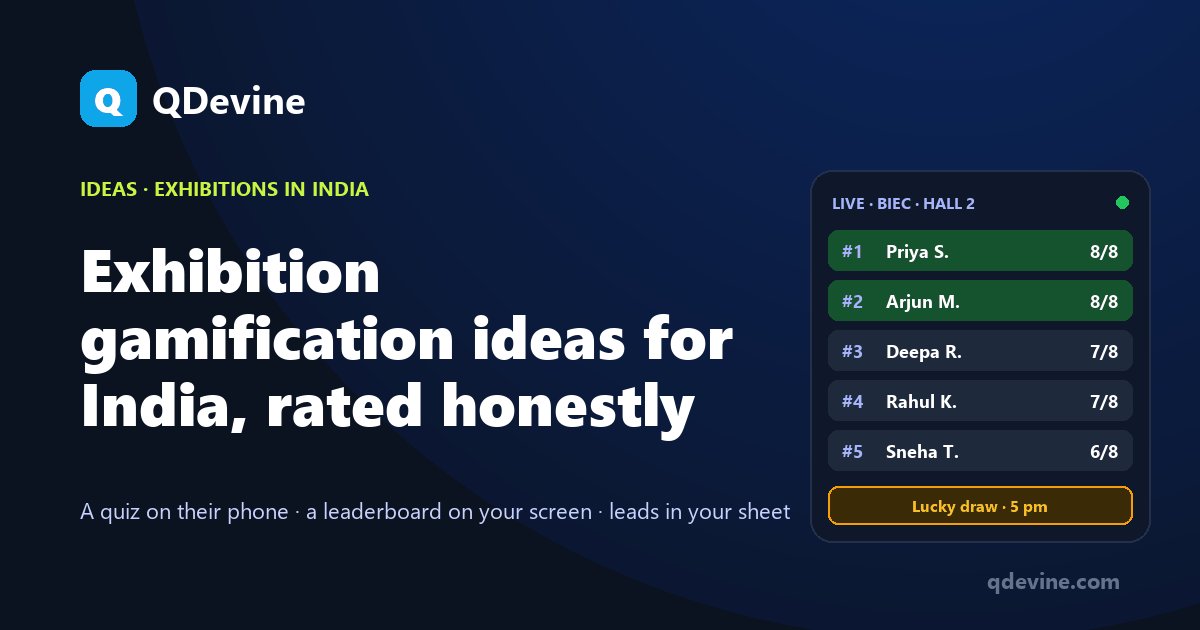
- A QR quiz with a live leaderboard. The visitor scans, registers with consent, answers timed questions on their own phone and watches their name move on the stall TV. The catch: you need eight decent questions and a TV. In return it is the only idea on this list that leaves you a consented lead list by evening.
Why the quiz is the one that leaves a list
Every other idea separates the game from the capture. The quiz merges them: registration is the first screen, the game is the reward for completing it, and the lead arrives with the score, the time and the consent wording attached. Nobody on your staff has to hold a tablet or ask for a card, so the stall keeps running while your team is in conversations.
It also absorbs ideas four, eight and nine. The leaderboard is the crowd magnet; the built-in lucky draw replaces the raffle drum and skips earlier winners; and Stage mode turns the same quiz into a hosted round for a seminar slot if you have one.
What works in an Indian hall specifically
- Mobile data, not stall Wi-Fi. Venue Wi-Fi at Pragati Maidan or BEC Mumbai is unreliable on a busy day. A visitor's own 4G handles the quiz because each answer is a few hundred bytes.
- Hindi as well as English. The player screens, buttons and consent lines exist in both, and the AI builder writes the questions in both. At a dealer-heavy show that is the difference between six plays and sixty.
- Prizes at set times. A draw at 1 pm and 5 pm gives people a reason to return, and the board shows the winner's name for 90 seconds so the whole aisle sees it.
- A rupee price with a GST invoice. One Event Pass at ₹9,999 plus GST covers a show for 30 days, paid by UPI or card. No dollar subscription to justify to finance.
How to set it up in an evening
Create an event, paste your questions or let the AI builder write them from your brochure PDF, choose the fields you want on the form, and print the QR onto a standee. Open the board link on the stall TV the next morning and press F11. Fictional example: Quorvex Analytics runs eight questions about data pipelines, asks one survey question about the visitor's biggest bottleneck, and draws a prize from the top ten at the end of each day. That is the whole plan.
Questions people ask about stall games
Which gamification idea gets the most leads?
The one that captures details as part of play rather than beside it. A QR quiz with a live board does that; a wheel, a photo booth or a VR headset needs a separate form that most visitors skip.
Can we combine a quiz with a spin-the-wheel or a raffle?
Yes. Many stalls use the quiz as the entry to the raffle: everyone who finishes is in the draw, and the built-in lucky draw picks a winner on the board at the time you announce.
What if the hall has no Wi-Fi at all?
Players use their own mobile data. Only the TV board needs a connection and a phone hotspot is enough for it, because the board fetches a small update every few seconds.
How many questions should a stall quiz have?
Five to eight, timed, with a one-line explanation after each. That keeps a play to about 90 seconds, which is as long as a visitor will stand in an aisle.
Read next
- Booth engagement ideas: the prize draw, the TV and the 90-second rule in more detail.
- Exhibitions and trade shows: the full walkthrough of a show on QDevine.
- The 90-second rule: why a booth quiz should be short, and how short.