The 90-second rule: how long a booth quiz should take and why
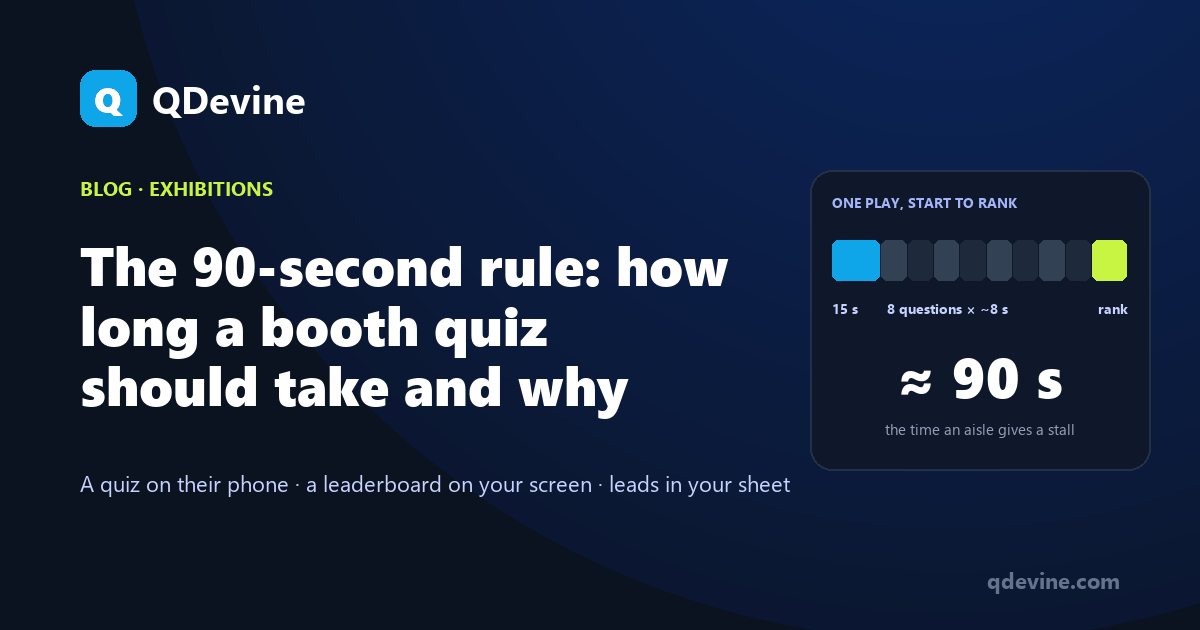
How long should a booth quiz take? About 90 seconds, and that is not a round number picked for a headline. It comes from how an aisle works, how a leaderboard works, and how much time a visitor gives a stranger's stall.
The aisle sets the budget
Watch a busy hall at Pragati Maidan or BEC Mumbai for ten minutes and you see the same thing at every stall. A visitor slows, looks, and decides in seconds whether to step in. If they do, they give the stall a short window before the next thing pulls them on: a colleague, a session, the stall opposite. Anything you ask of them has to fit that window, or be so good they choose to stay. Most stall activities are not that good, and they do not need to be. They need to be short.
A ten-minute quiz is a seminar. People skip it, or abandon it halfway, and an abandoned quiz is a lead with no score, no rank and no reason to come back for the prize. A 90-second quiz is something you do while your colleague finishes a conversation. It gets finished.
Why 90 seconds and not 30
Shorter is not automatically better. Registration takes about fifteen seconds: name, work email, maybe one custom field, the consent line. If the quiz after it is two questions, the visitor has spent longer signing up than playing and it feels like a form with a gimmick attached. Five to eight questions, each with a fifteen to twenty second timer and a one-line explanation, is long enough to feel earned and short enough that nobody checks their watch.
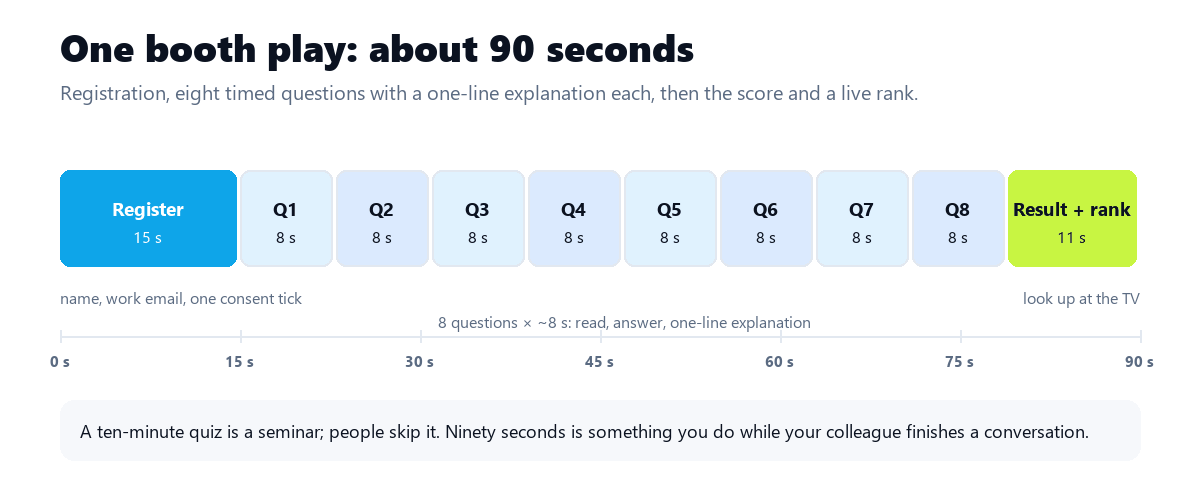
Eight questions also gives the leaderboard something to separate people with. Two questions and half the board is tied on 2 out of 2; ties then break on speed, which is fair but not much fun to look at. Eight questions spreads the scores, and a visitor who got 7 out of 8 wants to know which one they missed.
The board needs short plays
The leaderboard on the stall TV is the thing that draws the next visitor, and it only draws if it moves. A board that reacts to every answer, not just at the end of a play, changes constantly when plays are short and frequent. With 90-second plays, a stall with a modest stream of visitors has a name climbing or dropping on the screen every few seconds. With ten-minute plays, the board sits still and the aisle walks past it.
Short plays also keep the queue moving. One phone per visitor means there is no queue for a device, but there is a queue for attention: the person waiting to talk to your sales engineer will play while they wait if the play fits the wait.
What 90 seconds still leaves you
The point of a booth quiz is what you keep afterwards, and 90 seconds is enough for all of it. The visitor has given a name and a work email, ticked a consent line whose wording and time are in the ledger, answered one custom question such as their role, and read eight one-line explanations that are, quietly, your pitch. Score, time and rank go in the same CSV row. A badge scanner takes two seconds and leaves a badge record; the other 88 seconds are where the consent, the context and the reason to follow up come from.
How to set it up
- Five to eight questions per attempt. With a bigger pool, let each attempt draw a fixed number at random so repeat visitors see different ones.
- Set the per-question timer to 15 to 20 seconds. Long enough to read, short enough to keep the tie-break on speed meaningful.
- Keep the answer reveal to a few seconds with a one-line explanation, then auto-advance. This is where you say the thing you would have said in the brochure.
- Ask at most one custom question at registration and at most one survey question after the last answer. Every extra field costs finishers.
- Say the prize rule out loud and put it on the board: "top ten by 5 pm" gives the 90 seconds a reason.
Fictional example: Zentrivo Systems runs eight questions on cloud cost with a 15-second timer and a 5-second reveal. The whole play, registration included, lands at about a minute and a half, and the sales engineer has a name on the board to talk to before the phone is back in the pocket.
Questions about quiz length
Is 90 seconds long enough to learn anything about the visitor?
Yes, if you ask for one thing. One custom field at registration, such as role or product of interest, and one survey question at the end land in the same CSV row as the score. More fields cost you finishers.
Should a dealer meet or training quiz also be 90 seconds?
No. A room that has set aside time can take ten or more questions in Stage mode. The 90-second rule is about the aisle, where the visitor's time is borrowed.
What timer per question works best on a stall?
Fifteen to twenty seconds. Shorter and people miss questions on a slow 4G day; longer and the play drifts past two minutes.
What happens if a visitor abandons the quiz halfway?
Their registration and consent are already stored, and the board marks them as still playing. They can return to the same link and finish, and staff can reset the attempt from Live Ops if needed.
Read next
- Booth engagement ideas: the prize draw, the TV and staffing that lets one person run it.
- Exhibitions and trade shows: a show on QDevine from set-up to the CSV.
- Consent at the stall: what those fifteen seconds of registration have to get right.